AI is used in commercial real estate underwriting mainly to read: it pulls the figures out of offering memorandums, rent rolls, T12s and operating statements, maps them into a model, and flags where the sources disagree. The arithmetic — NOI, debt service coverage, IRR, the waterfall — should stay with deterministic code, and the decision with the underwriter.
That division of labour is the useful way to think about AI in underwriting, and most of what goes wrong with it comes from blurring it. This guide walks through where AI fits in each step of an underwriting, what actually breaks when a model reads deal documents (with examples from our own extraction work), and the questions to ask before you trust a tool’s numbers.
What is the role of AI in CRE underwriting?
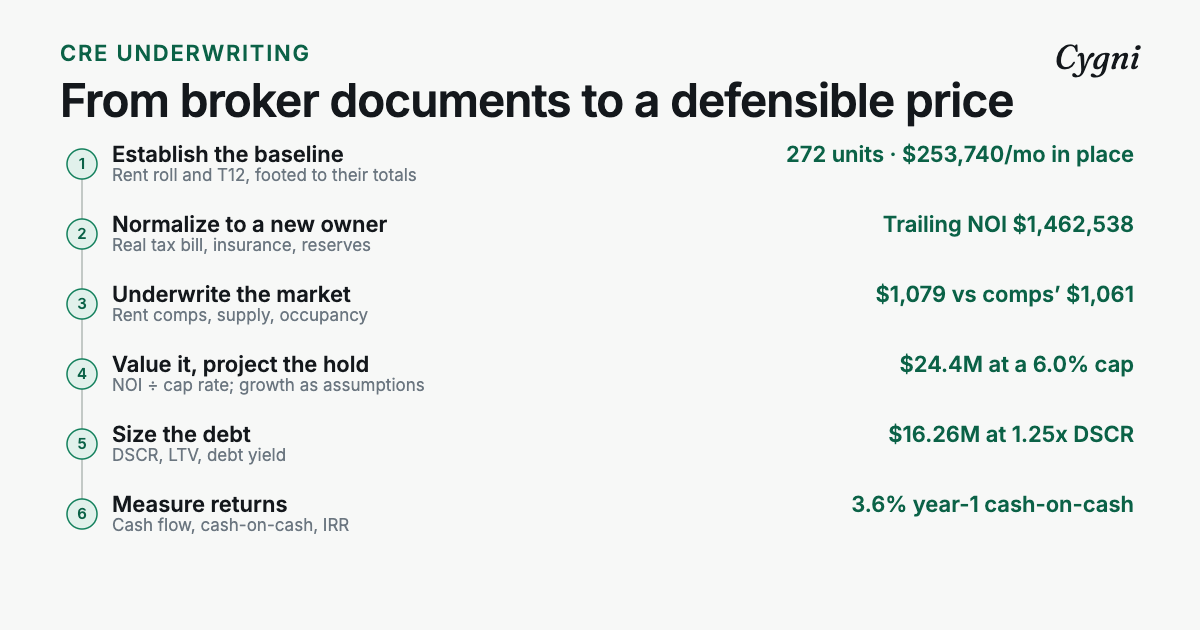
An underwriting turns a stack of broker and third-party documents into a projection you can decide on (the full process, without the AI, is in our guide to CRE underwriting). AI is useful at some steps and the wrong tool at others.
- Sorting the documents. A deal room holds an OM, a T12, a rent roll, maybe a P&L and a broker pro forma. AI identifies which document is which and which pages carry the income statement, the unit mix or the rent roll.
- Extracting the figures. Line items as the document prints them — gross potential rent, vacancy, concessions, other income, each operating expense — and, from the rent roll, every unit’s type, square footage, in-place rent, market rent and lease dates. This is the step AI changes most, because it replaces retyping.
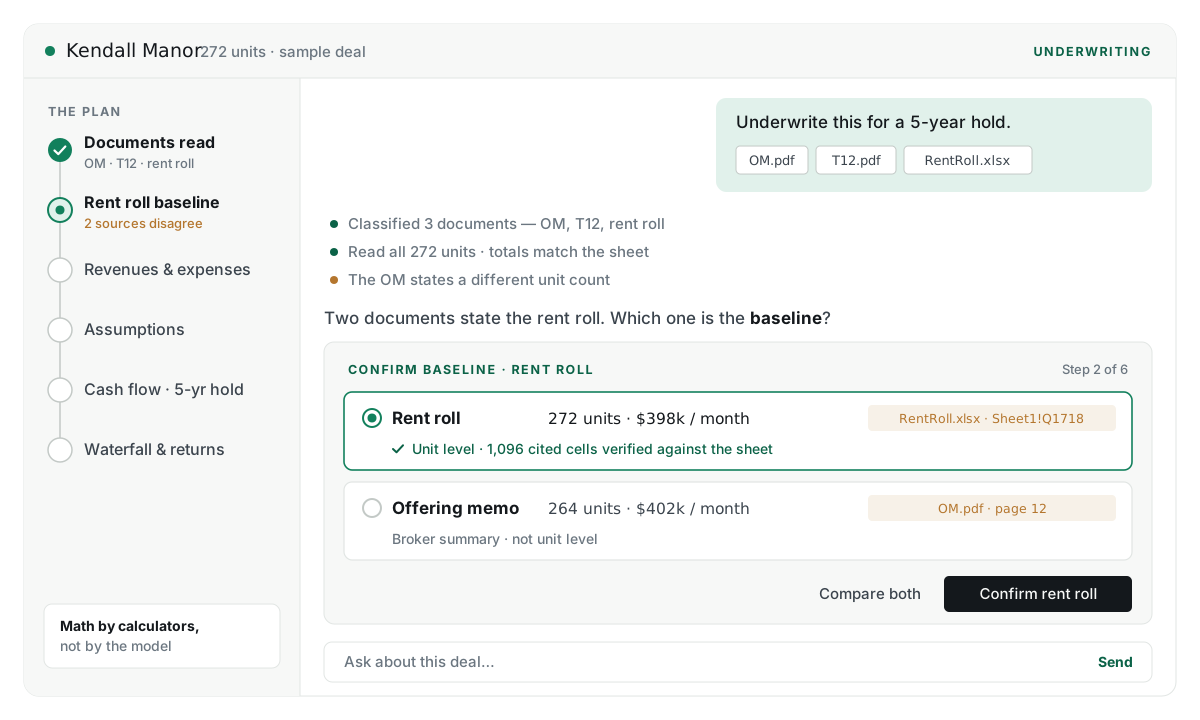
- Reconciling sources. The same number often appears in several places: the OM restates the rent roll, and the broker’s pro forma sits next to the trailing twelve months. AI can line the candidates up and show where they differ. Which one becomes the baseline is the underwriter’s call.
- Researching assumptions. For rent comps, market vacancy or a land deal with no operating history, AI can search and summarise — with sources, so the assumption can be checked.
- Running the model. AI can decide which calculation to run and with what inputs. The calculation itself — the cash-flow proforma across the hold period, the debt schedule, the IRR and LP/GP waterfall — should be code.
- Drafting the summary. Turning the results into an investment memo is a writing task, and models are good at it, provided every figure in the memo comes from the model rather than from the prose.
How widely is AI used in commercial real estate today?
Widely tried, rarely finished. In JLL’s 2025 Global Real Estate Technology Survey of more than 1,500 senior investor and occupier decision-makers, 88% of investors, owners and landlords had started piloting AI, but only 5% reported achieving all their program goals. Deloitte’s 2027 Commercial Real Estate Outlook, based on a survey of 950 industry leaders in June and July 2026, puts it the same way: 92% of respondents are piloting or researching AI, and only 8% have integrated it.
Both reports point at the same obstacle, and it is not the models. JLL attributes the gap to organisational readiness, “including whether they have quality data”; Deloitte cites “uneven data foundations” among the constraints. For underwriting, the data foundation is the documents — which is why the reading step, and whether you can trust what it produced, decides how far AI gets you.
The upside is real. Morgan Stanley Research analysed the tasks performed at 162 REIT and commercial real estate firms and estimated that 37% of them could be automated, worth $34 billion in efficiency gains by 2030 — concentrated in management, sales, administrative support and maintenance rather than in investment decisions.
What should AI do in an underwriting — and what shouldn’t it?
| Task | Who should do it | Why |
|---|---|---|
| Reading OMs, T12s and rent rolls | AI | Layouts vary endlessly; retyping is slow and error-prone |
| Recording where each figure came from | AI, as a citation | A number without a source cannot be checked |
| NOI, DSCR, IRR, the waterfall | Deterministic code | Same inputs must give the same answer, and a calculator can be tested |
| Checking extractions against the document’s printed totals | Code | A check the model reports about itself is not a check |
| Choosing the baseline when documents disagree | Underwriter | It is a judgment about which source to trust |
| Rent growth, vacancy, exit cap, capex | Underwriter (AI can research) | The assumptions are the bet |
| The investment or credit decision | Underwriter / investment committee | — |
The middle rows are where tools differ most. A language model generates text: it can produce arithmetic that looks right and isn’t, and it can answer the same question two different ways. That is acceptable for drafting a paragraph and unacceptable for a debt service coverage ratio a lender will rely on.
What goes wrong when AI reads underwriting documents?
The failure that matters is not an obvious error. It is a confident, well-formatted, wrong result. Three examples from building Cygni’s own extraction, anonymised:
The rent roll that stopped at unit 56
A 272-unit rent roll, exported from property management software as a spreadsheet. Asked to transcribe the rows, a model returned 56 units. The output was valid, the units were consecutive, and nothing — no error, no warning, no truncation marker — said it had stopped early. A model writing out rows one by one can simply decide it is done.
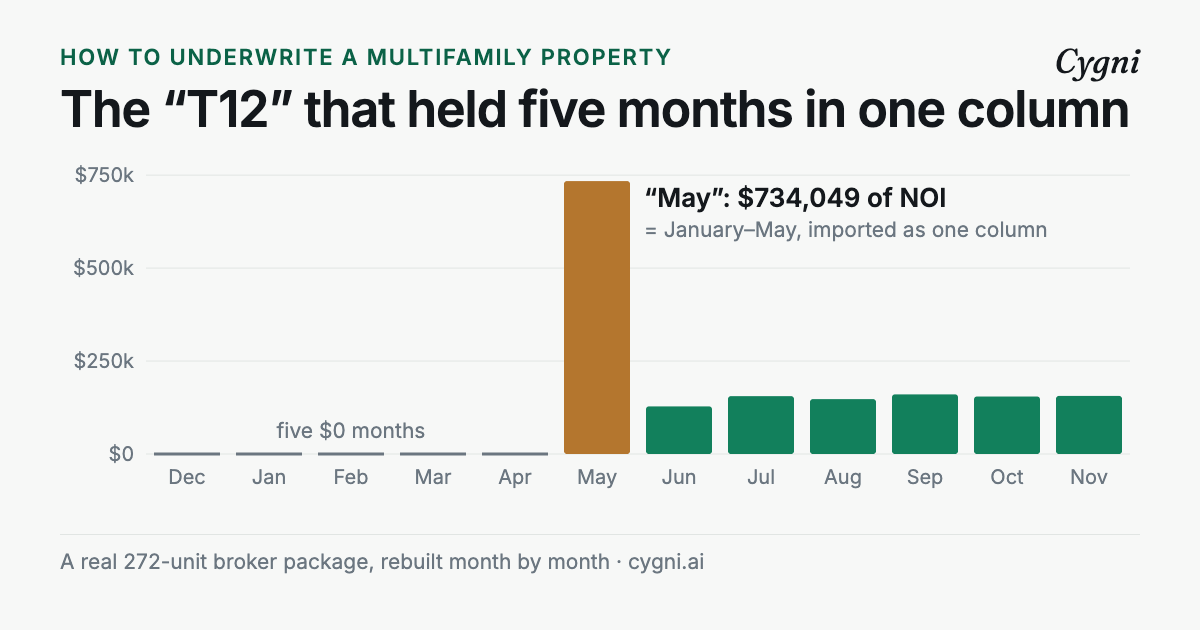
The fix was to stop asking the model to type rows at all. It now writes a short program that reads the spreadsheet, and the program emits the rows. The same rent roll came back with all 272 units, and every one of the 1,096 cell references it cited was checked against the actual spreadsheet before the result was stored. That rent roll belongs to a real deal we walk through end to end in how to underwrite a multifamily property, T12 and pro forma included.
The legend that became 16 extra units
On a later run the count came back as 288. The extraction had swept the charge-code legend printed below the units — rent, parking and pet-fee codes — into the unit list. The spreadsheet prints its own total, 272, and comparing the extraction against that printed figure (a cross-foot) rejected it. Told which direction the error ran and shown a sample of what it had counted, the next attempt returned 272.
The rent column that still added up
The third example is the important one. Comparing models on an offering memorandum’s rent roll, one model shifted the rents up one row from a single unit onward, so seven units carried their neighbour’s rent. The column still summed to the page’s printed total, $69,380, exactly. A totals check passed an extraction that was wrong.
What these add up to:
- Silence is not success. A tool should say what it could not verify, not just what it found.
- Check against the document’s own totals — and know that check catches missing and extra rows, not values in the wrong place.
- Every figure needs its own source, a page or a cell, so a misplaced value can be spotted by looking.
- Confirm the baseline before projecting from it. The rent roll, revenues and expenses are what every later number is arithmetic on; a person checking them beside the source is the step that catches the third example.
How does AI underwriting compare with manual and spreadsheet underwriting?
| Manual | Spreadsheet template | AI-assisted | |
|---|---|---|---|
| Getting data in | Retyped from PDFs | Retyped or pasted into the template | Read from the documents |
| Where a number came from | The analyst’s notes, if any | A cell — but not the page it was typed from | The page or cell it was read from |
| Consistency | Varies by analyst | The template enforces structure | Same documents, same extraction; calculators give the same result |
| Typical failure | A typo or a skipped line | A broken formula or a hard-coded override | A confident misread or a silent omission |
| How it gets caught | A second analyst re-checks | A formula audit | Citations, totals checks and confirmation |
AI does not remove the need for review; it changes what review looks like. Instead of re-keying a T12 to check it, the underwriter scans extracted values beside their sources.
Is AI underwriting different for lenders and investors?
The reading step is the same: a lender and an equity investor look at the same T12 and the same rent roll, so the extraction problems above apply to both. What differs is what gets computed on top. A lender sizes the loan on debt service coverage — annual net operating income divided by the required annual debt service, as the FHFA’s multifamily underwriting examination guidance defines it — along with debt yield and loan-to-value, and weighs the borrower as much as the building. An investor sizes the return: cash-on-cash, IRR, equity multiple, and how distributions flow through the waterfall to the limited and general partners. In both cases those figures should come from calculators fed by confirmed inputs.
How do you evaluate an AI underwriting tool?
Ask these in the demo, using one of your own deals:
- Can you click any number and see the page or cell it came from?
- Does it check its extraction against the totals the document prints — and tell you when it couldn’t?
- What happens on a long rent roll? Bring a 250-unit export and count the units that come back.
- Who does the math — the model or code? Run the same deal twice; the numbers should not move.
- When the OM and the rent roll disagree, does it pick one silently or show you both?
- Can you correct a value, and does the correction flow through the model?
- Does it keep what a document states separate from what is projected? A trailing-twelve column is history; it is not year one of a forecast.
- Can you take the model and its assumptions out with you?
Cygni was built around these questions: every extracted figure carries the page or cell it was read from, spreadsheet citations are verified against the parsed grid, and the projection and waterfall are computed by deterministic calculators rather than by the model. See how document intelligence handles rent rolls, T12s and OMs.
Will AI replace commercial real estate underwriters?
No. It replaces the retyping. The work that decides a deal — choosing which source to trust, setting rent growth and exit assumptions, judging the sponsor and the market — is judgment, and it gets more of the underwriter’s time once the data entry is gone. The underwriters who benefit most treat AI output the way they would treat a junior analyst’s first pass: useful, fast, and checked against the source before anything is built on it.
Frequently asked questions
How is AI being used in commercial real estate underwriting?
Mostly to read. AI extracts the figures from offering memorandums, T12s, operating statements and rent rolls, maps them into a model, cites where each one came from, and flags where two documents disagree. Some tools also use it to research market rents and draft the investment summary. The arithmetic and the decision should stay with deterministic calculators and the underwriter.
How does AI improve the accuracy of commercial real estate underwriting?
By removing retyping, which is where most transcription errors come from, and by attaching a source to every figure so a reviewer can check it in seconds. AI does not make a model accurate on its own: it can misread a value or skip rows, so accuracy comes from the checks around it — citations, comparison against the totals the document prints, and a person confirming the extracted values.
Can AI calculate NOI, DSCR or IRR?
It shouldn't. A language model generates text, so it can produce arithmetic that looks right and isn't, and it can give different answers to the same question. Calculations like NOI, debt service coverage, IRR and an equity waterfall belong in deterministic code that returns the same result every time and can be tested. The AI's job is to supply the inputs and choose which calculation to run.
Can AI completely replace human underwriters?
No. AI removes the data entry, but the parts of underwriting that decide a deal — which source to trust, what rent growth and exit cap to assume, whether the sponsor and the market support the plan — are judgments. If anything, they get more of the underwriter's time once the retyping is gone.
Will AI eliminate manual document review in underwriting?
It changes it. Instead of typing figures in, the underwriter reviews what the AI extracted, with each value shown beside the page or cell it came from. That review is faster than retyping, and it should not be skipped: confirming the extracted baseline is what makes every number built on it defensible.
What documents can AI read for real estate underwriting?
Offering memorandums, T12s and other operating statements, profit and loss statements, rent rolls and broker pro formas — as PDFs, scanned images or Excel files. Spreadsheets and PDFs need different handling: a PDF is read page by page, while a large spreadsheet is best parsed by code rather than transcribed by a model.